Monday, January 8, 2024

Mongolia | Wanders in the Khentii Mountains of Mongolia | Onon Hot Springs

I have visited the Onon Hot Springs in the upper Onon Valley three times: once while on my first trip into the Khentiis in 1997; once while doing the Khora around the Burkhan Khamag of the Khamag Mongols; and yet again in 2007, when I made a trip to the springs for therapeutic purposes. The springs are famous for treating diseases and afflictions of the lower body: knees (mud packs taken from near the springs are especially good for knee joints), lower back pain, kidney and liver problems, and rheumatism and sore muscles in general. Zevgee wanted to treat his knees, which had become wobbly with the advancing years, I am concerned about my lower back, which had been acting up for the past several years. Zevgee’s wife, Tümen-Ölzii, had no specific ailments but just wanted to enjoy the rejuvenating effects of the springs. Zevgee’s son Batdorj and grandson Puntog would come along on a break from the daily chores of herding livestock and to help Zevgee with the horses.

Puntog, Zevgee, Batdorj, Tümen-Ölzii (click on photos for enlargements)

From Zevgee’s ger at the confluence of the Kherlen Gol and Terelj Gol we took the by-now familiar trail up the east bank of the Kherlen, past Erdene Uul, the Burkhan Khaldun of the Uriangkhai, to the Shirengetei Gol, and then rode up Shirengetei Valley. At places a two-rutted path could just be made out. According to Tümen-Ölzii, locals called this path Zanabazar’s Road. Zanabazar, the First Bogd Gegeen, had, it was claimed, visited the Onon Hot Springs on an almost yearly basis. He probably came here from Saridag Khiid, the monastery that I had visited earlier. From Saridag Khiid he would have taken a small tributary of the Tuul Gol to Bürkhiin Davaa and then down the valley of the Bürkh Gol to the Kherlen Gol—the same route I had taken when I visited Saridag Khiid—and then followed the Shirengetei Gol upstream on the path that now bears his name. 
Zanabazar’s Road (foreground), and the Shirengetei Gol Valley

We camped for the night in the upper Shirengetei Valley and the next day crossed Baga Davaa and Ikh Davaa into the drainage of the Onon Gol. We stopped that night in the valley of the Tsonj Chuluu Creek at the same clearing we had camped at on my previous two trips to Onon Hot Springs. The next day we continued on to the Onon Gol, just below its beginning at the confluence of Tsonj Chuluu Creek and Öngöljin Creek. On my previous two trips we had proceeded down the east bank of the Onon Gol. There was a trail of sorts but at times we had to ride through swamps and standing water. Twice my horse floundered in knee-deep mud. Since then hunters had told Zevgee that there was a better trail down the west bank of the river. Crossing the Onon Gol we soon picked up the faint trail. The terrain on the west bank was elevated and dry and the forest was relatively free of down timber. At places there was just a hint of a two-rutted path. This, Zevgee concluded, must be the route used by Zanabazar. Although at times the trail meandered a half mile or more from the river it was easy going and we arrived at the hot springs by late afternoon . . . Continued


Thursday, January 4, 2024

Mongolia | Wanders in the Khentii Mountains of Mongolia | The Source of the Amur River and the Birthplace of the Mongols

The Amur River is, according to most sources, the tenth-longest river in the world. The Amur flows into the Strait of Tartary, which separates Sakhalin Island from mainland Asia. The Strait of Tartary opens to the north into the Sea of Okhotsk, part of the Pacific Ocean. The Amur River proper begins at the confluence of the Shilka and Argun rivers and flows 1755 miles to the sea. The 348-mile-long Shilka River begins at the confluence of the Ingoda and Onon rivers. The Onon, the larger of the two and thus considered the ultimate source of the Amur River System, measures 641 miles in length. Thus the entire Onon-Shilka-Amur River System is 2,744 miles long. Some reference works maintain, however, that the ultimate source of the Amur River System is the Kherlen River, which flows east out of the Khentii Mountains and eventually debouches into Khölön Lake (also known as Dalai Nuur) in the Chinese province of Inner Mongolia. Normally it is an endorheic lake with no outlet, however, and only at times of high water does Khölön Lake overflow into the Argun (Ergüne) River, which flows northeast and eventually combines with the Shilka River to form the Amur River. The fact that the Kherlen-Khölön Lake-Argun-Amur River System does not flow continuously seems to disqualify it in the eyes of most authorities, including the Times Altas of the World (wikipedia.com names the Onon as the source of the river system, with the Argun-Kherlen as a “2nd source”). 


 During my first trip into the Khentii Mountains in 1997 I crossed Ikh Davaa, which separates the drainages of the Kherlen Gol and the Onon Gol, and then followed Tsonj Chuluu Creek downstream to its confluence with Öngöljin Creek. This is the actual beginning of the Onon River. Öngöljin Creek is the bigger of the two creeks that combine to form the Onon. Therefore the true, ultimate source of the Onon-Shilka-Amur River System is the source of Öngöljin Creek, a detail left out of all atlases and other authorities. On that first trip into the Khentiis I was hell-bent on visiting Onon Hot Springs and ascending the sacred mountain of Burkhan Khaldun (Khentii Khan Uul), so I did not trace Öngöljin Creek to its beginning. I did decide that one day I would return and locate the source of Öngöljin Creek, the true beginning of the Öngöljin Creek–Onon–Shilka-Amur River System. My original plan was to retrace my 1997 route to the beginning of the Onon Gol and then proceed upstream on Öngöljin Creek . . . Continued.


Mongolia | Wanders in the Khentii Mountains of Mongolia | Saridag Khiid and Yestiin Hot Springs

While browsing in a bookstore in Ulaanbaatar I came across a short biography of Zanabazar (1635-1723), the First Bogd Gegeen of Mongolia, written by a Mongolian historian. Nowadays Zanabazar is perhaps best known for his artwork. I had already seen examples of his famous bronze statues in the Zanabazar Fine Arts Museum, the Choijin Lama Museum, and the Bogd Khan Winter Palace Museum, but at that point I knew very little about his life. Zanabazar was a polymath who addition to being an artist had designed and built new temples, invented two new scripts for writing the Mongolian language, and fashioned new clothes for monks. He also studied the medical properties of hot springs. According to the author of the biography, these included the Onon Hot Springs, which I had visited on my first trip into the Khentii Mountains, the Minj Hot Springs on the Minj Gol in the northern Khentiis, and Yestiin Hot Springs. The author made no mention of where the Yestiin Hot Springs were located, but I assumed they were somewhere in the Khentii Mountains, where Zanabazar had established a large monastery. The first opportunity I had I asked Zevgee, the Kherlen Valley herdsman who had acted as my guide on my previous trips into the Khentiis, if he knew anything about Yestiin Hot Springs. Of course he knew. He said he had been there numerous times. The hot springs were about a three-day ride by horse from his ger near the confluence of the Kherlen Gol and the Terelj Gol. Thus a couple of years after my first trip into the Khentiis I made arrangements to visit Yestiin Hot Springs.

While on the way to Yestiin Hot Springs I stumbled upon the ruins of Saridag Khiid, the monastery founded by Zanabazar in 1654. The monastery was totally destroyed by Zanabazar’s arch-nemesis Galdan Bolshigt in 1688, and for over 300 years the ruins, in a remote area of the Khentii Mountains, were visited only by hunters and plant-gatherers . . .  Continued.

Monday, December 18, 2023

Iran | Tabriz | Covered Bazaar | Tea

Wandered by Tabriz, a city of some 1.7 million souls—the fifth largest city in Iran. In 1655 the legendary Turkish gadabout Evliya Çelebi ((1611–1682; his mammoth Book of Travels—ten volumes, only eight have survived—is what his translator calls “probably the longest and most ambitious travel account by any writer in any language.”) spent two months in Tabriz and observed:

. . . in the entire kingdom of Persia there is no city and no countryside as fine as Tabriz, the ravisher of hearts . . . It is a large and ancient city with delightful climate, lovely boys and girls, lofty buildings and numerous foundations and institutions. May God allow that it will once again belong to the Ottomans [the Ottoman Turks had occupied Tabriz from 1585 to 1603] . . . may God Most High cause it to flourish forever!

Hotel in Tabriz where I stayed (click on photos for enlargements)

View of Tabriz from my hotel room

While in the city I visited the famous Tabriz Bazaar, said to be the largest covered bazaar in the world. It covers 66.7 acres, with 3.41 miles of passageways and 5500 shops. The Grand Bazaar of Istanbul, while ranking as the biggest single tourist attraction in the world, with over 91,000,000 visitors a year, has between three and four thousand shops. The largest mall in the United States, the Mall of America in Bloomington, Minnesota covers more space than the Tabriz Bazaar—96.4 acres total with 56.8 acres devoted to 530-some shops—but many would argue that it is not a covered bazaar in the classic sense of the term but rather a New World mutation.

Gallery in the Tabriz Bazaar

Of course I gravitated to the tea shops. Here tea is sold by the kilo out of big wooden bins, as God intended, not in ridiculous little tea bags.

Tea for sale in the Tabriz Bazaar


 Green tea (Chai Sabz) grown in Lahijan, a city in Gilan Province in northern Iran, just south of the Caspian Sea). The sign indicates that this tea is Chin Bahara (spring pick). I like that they say when the tea is picked. Freshness is crucial with green tea.

Sunday, December 17, 2023

Italy | Venice | Palazzo Rizzi


Wandered by Venice and am back in my usual digs, an old nunnery which has been converted into a hotel. The building, once the Palazzo Rizzi, is located on the Fondamenta Rizzi, about a five minute walk from the Piazzale Roma, where all buses from the mainland terminate. The hotel is still owned and operated by St. Joseph’s Daughters of Caburlotto, the religious order that occupied the nunnery. As befitting an old nunnery, the rooms are tiny and spartan, to say the least. My bed is about three feet wide—all that was needed by a nun—and my ankles hang over the end, but the room does have a desk and enough electrical outlets to keep all my devices topped up. What else does one need in a room? There is also a midnight to 6:00 a.m. curfew. You cannot enter or leave the building during those hours. This is of no importance to me. Venice is not a night-life city by any stretch of imagination, and I myself would never have any reason to stay out past midnight. The Fondamenta Rizzi, the walkway on which the hotel is located, does not even have a convenience store and is as quiet as Ligeia’s tomb after nine p.m. 

Fondamenta Rizzi on the right (click on photos for enlargements)
The old Palazzo Rizzi, later a nunnery and now a hotel
Venice
Venice. The leaning bell tower is not a photographic distortion. It actually does lean that way.
Canal of San Luca
The Piazzetta in Venice
Piazza and Church of San Marco
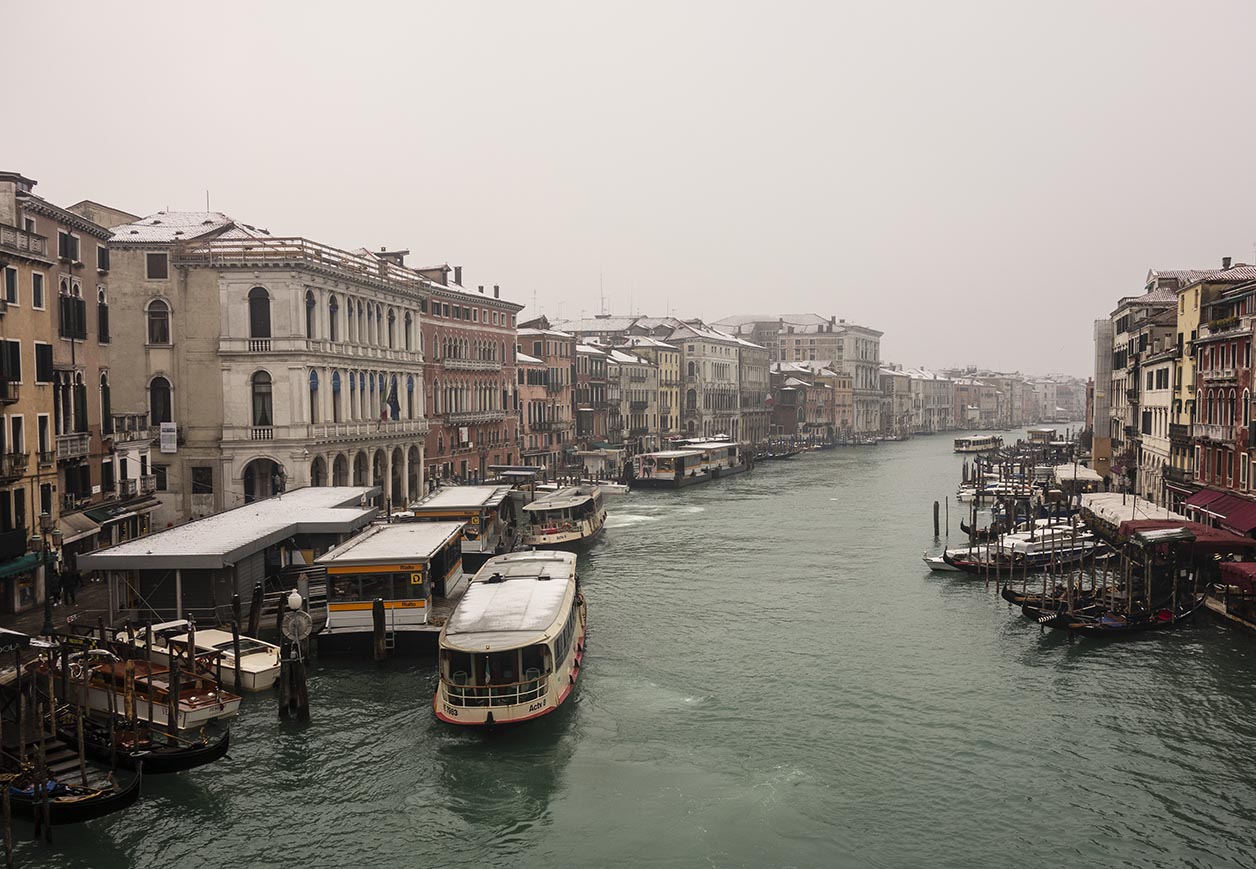
Grand Canal from the Rialto Bridge

Friday, December 8, 2023

Mongolia | Ulaanbaatar | Soyolma

New painting by Mongolian artist Soyolma (click on photos for enlargements).

Soyolma in her studio. The painting  behind her is now in my Zaisan Tolgoi Galleria.

Soyolma’s painting in my Galleria

Soyolma is also a thangka painter. Here is a White Tara thangka she painted for me. 
Now in my Galleria. 

Wednesday, November 29, 2023

Iran | Yazd

Wandered by Yazd, a city of about one million people located near the middle of Iran. It is known as one of the hottest cities in the country. As with many cities in the desert water is held in high regard. 
 Main square of Yazd (click on photos for enlargements)
 Main square of Yazd
 Main square of Yazd
Kids playing in the main square of Yazd. The city’s famous wind-catchers, which catch cool breezes and funnel them down into the buildings below, can be seen in the background. The wind-catchers were an early form of air-conditioning. 
 Skyline of Yazd with more wind-catchers
Wind-Catchers
Streets of Yazd
 Mosque in Yazd
 Detail of mosque in Yazd
  Detail of mosque in Yazd
 Hotel where I stayed in Yazd
 Courtyard of hotel where I stayed in Yazd
  Courtyard of hotel where I stayed in Yazd
Courtyard of hotel where I stayed in Yazd. The perfect place for sipping a saffron tisane as the air cools off at twilight. 

Italy | Venice | Early Life of Enrico Dandolo

There are few greater ironies in History than the fact that the fate of Eastern Christendom should have been sealed—and half of Europe conde...