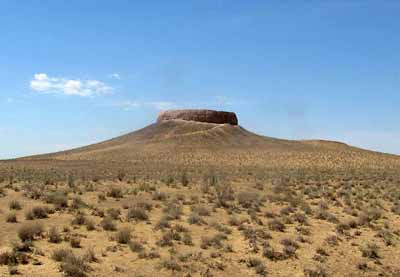
Showing posts with label Khwarezm. Show all posts

Thursday, October 14, 2021

Uzbekistan | Khorezm | Nukus | Fifty Forts Region


From Khiva I wandered on down the Amu Darya River (also known as the Oxus)  to the city of Nukus. Actually I did not want to go to Nukus. I was much more interesting in the ruins of the old Silk Road cities and fortresses scattered along the north bank of the Amu Darya, but my driver insisted that all tourists who come this way go to Nukus to visit the Karakalpakstan State Museum of Art. Unfortunately he did not point out why all tourists go to the Karakalpakstan State Museum. It turns out, according to A Recent Story In The New York Times, that this “museum in the parched hinterland of Uzbekistan . . . is home to one of the world’s largest collections of Russian avant-garde art.”


I did not know this at the time. I did peek through a few doorways into galleries containing what looked like avant-garde art, but of course I did not go in, since I have not the slightest interest in anything avant-garde and indeed little interest in any art created since the fall of the Ottoman Empire. I did spend an enjoyable couple of hours examining the museum’s fair to middling collection of Zoroastrian Ossuaries, which was especially interesting to me since I had just recently visited a Zoroastrian Tower of Silence, also on the banks of the Amu Darya, where human corpses were stripped of their flesh so their bones could be collected and placed in funeral urns like these. I also drooled over the museum’s small but mouth-wateringly delectable collection of antique Turkmen Carpets.  


But enough of that. From Nukus we proceeded eastward along the northern bank of the Amu Darya through what is known as the Ellik Kala, or Fifty Forts Region. The area is dotted with ruins of cities and forts dating from perhaps the third or fourth century BC to the seventh century AD. At one time many of these settlements would have served as important way-stations on the Silk Road between Bukhara and Samarkand to the east and Kunya Urgench, farther on down the Amu Darya. 


 Kyzyl Kala (Fortress)


 Ruins of Toprak Kala, dating to about 2000 years ago


  Ruins of Toprak Kala


  Ruins of Toprak Kala
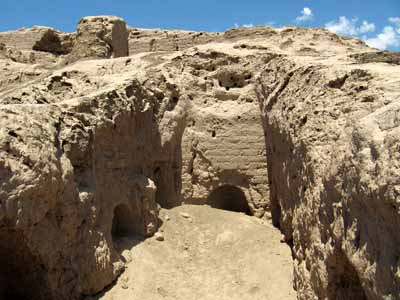


  Ruins of Toprak Kala


  Ruins of Toprak Kala


Aerial view of the ruins of the lower fortress of Ayaz Kala. Built sometime in the 4th–7th centuries AD, the fortress may have been destroyed during the Mongol Invasion of Khorezm in the 1220s (see Enlargement). The ruins of the old city can be seen to the left of the fortress. 


Ruins of the lower fortress of Ayaz Kala


Ruins of the lower fortress of Ayaz Kala


 Ruins of the lower fortress of Ayaz Kala


Just north of the Lower Fortress on a higher summit is another larger fortress dating back to the 4th century BCE.


Aerial View of Upper Fortress (see Enlargement)


 Ruins of the upper fortress of Ayaz Kala


 Ruins of the upper fortress of Ayaz Kala


Ruins of the upper fortress of Ayaz Kala

Tuesday, April 14, 2020

Uzbekistan | Khoresm | Zoroastrians | Tower of Silence

Zoroastrianism, founded in Persia in perhaps the 6th century BC by the mysterious character known as Zoroaster, a.k.a Zarathustra of “Thus Spoke Zarathustra” fame, is probably the world’s oldest “revealed” religion, and as such Zoroastrians are even regarded as “People of the Book”, along with Christians and Jews, by at least some Muslims (sorry, Buddhists remain garden-variety Idolators). The major premise of Zoroastrianism, as you no doubt know, is the vast cosmic struggle between Ahura Mazdah, the God of Light (very roughly speaking), and Ahriman, the principal of Darkness and Evil. Zoroastrianism was very widespread in the Transoxiania and Khorezm regions before the arrival of the Islam in the eight and ninth centuries. For an utterly titillating account of Zoroastrianism see In Search of Zarathustra. For still more see Magi

Zoroastrian Burial Practices are of special interest. Bodies were placed on high hills or man-made summits and exposed to scavengers who soon stripped the bones clean. The bones were then preserved in containers known as ossuaries. A high place where the bodies were laid out was known as a Tower of Silence. One such Tower of Silence is located on the right bank of the Amu Darya River northeast of Khiva. After my stay in Khiva I wandered by this Tower of Silence.
Tower of Silence on the north bank of the Amu Darya 
This particular Tower of Silence a man-made structure on top of a natural hill
Closer view of the man-made platform at the top of the hill
The south side of the platform
View south from the entranceway
The flat top of the burial platform with the Amu Darya in the distance
Another view of the flat top of the platform. Bodies were left here to be stripped down to the bones by vultures.
Irrigated lands next to the Amu Darya
Another view of irrigated lands next to the Amu Darya
The Amu Darya from the top of the Tower of Silence

Uzbekistan | Khoresm | Zoroastrians | Tower of Silence


Zoroastrianism, founded in Persia in perhaps the 6th century BC by the mysterious character known as Zoroaster, a.k.a Zarathustra of “Thus Spoke Zarathustra” fame, is probably the world’s oldest “revealed” religion, and as such Zoroastrians are even regarded as “People of the Book”, along with Christians and Jews, by at least some Muslims (sorry, Buddhists remain garden-variety Idolators). The major premise of Zoroastrianism, as you no doubt know, is the vast cosmic struggle between Ahura Mazdah, the God of Light (very roughly speaking), and Ahriman, the principal of Darkness and Evil. Zoroastrianism was very widespread in the Transoxiania and Khorezm regions before the arrival of the Islam in the eight and ninth centuries. For an utterly titillating account of Zoroastrianism see In Search of Zarathustra. For still more see Magi


Zoroastrian Burial Practices are of special interest. Bodies were placed on high hills or man-made summits and exposed to scavengers who soon stripped the bones clean. The bones were then preserved in containers known as ossuaries. A high place where the bodies were laid out was known as a Tower of Silence. One such Tower of Silence is located on the right bank of the Amu Darya River northeast of Khiva. After my stay in Khiva I wandered by this Tower of Silence.


Tower of Silence on the north bank of the Amu Darya 


This particular Tower of Silence a man-made structure on top of a natural hill


Closer view of the man-made platform at the top of the hill


The south side of the platform


View south from the entranceway


The flat top of the burial platform with the Amu Darya in the distance


Another view of the flat top of the platform. Bodies were left here to be stripped down to the bones by vultures.


Irrigated lands next to the Amu Darya


Another view of irrigated lands next to the Amu Darya


The Amu Darya from the top of the Tower of Silence


Monday, April 8, 2013

Uzbekistan | Khwarezm | Janpiq Qala

From Gyaur Qala we drove southeastward 4.5 miles to Janpiq Qala. Built in the ninth or tenth century a.d. during an economic boom in Khwarezm, it was situated on the site of an older fortress dating back to the period between the fourth and first centuries b.c. The walled city, measuring 1500 feet long and up to a thousand feet wide, developed into a substantial craft center with quarters devoted to weaving, stone carving, blacksmithing, and the manufacture of glass and pottery. It was also an important trade entrepôt on the Amu Darya where goods from China, India, Egypt, and the Volga River and Black Sea regions all washed up. Russian researchers have suggested that a large breach in the southern wall was made by the besieging Mongols when they attacked Khwarezm in the winter of 1220-1221, perhaps with a huge battering ram. How much other damage the city suffered at the hands of the Mongols is unclear, but the city did recover and it eventually regained much of its former prominence (the breach in the southern wall was repaired). The city was attacked yet again by Amir Timur (Tamerlane) when he swept through the area in 1388. It never recovered from this onslaught, but the substantial ruins of the fortress and citadel walls have survived to the present day. 
Janpiq Qala (click on photos for enlargements)
Eastern wall of the fortress

Tower at the northeast corner of the fortress
Northern Wall
Northern Wall
Western Wall
Western Wall
Remains of tower in the wall
Eastern Wall
Tower in Eastern Wall
Outside of wall showing the opening allegedly made by the Mongols
Inside of wall showing the opening allegedly made by the Mongols
Entranceway from the outside
Entranceway from the inside
Southern Wall
Interior of the fortress 
 Ruins of Citadel 
 Ruins of Citadel 
 Ruins of Citadel 
Ruins of Citadel

Italy | Venice | Early Life of Enrico Dandolo

There are few greater ironies in History than the fact that the fate of Eastern Christendom should have been sealed—and half of Europe conde...