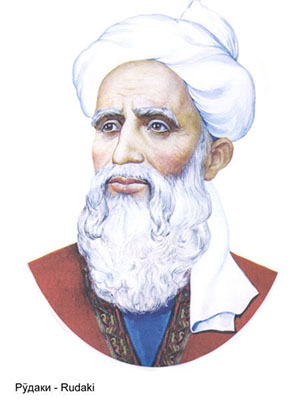
Monday, December 24, 2012

Tajikistan | More On Rudaki

Still trying to straighten out where 10th century Persian Poet Rudaki was born and buried. As noted earlier, a source in Samarkand indicated that he may have been born near the Town of Urgut in Uzbekistan, very close to the Tajikistan border. Most written sources indicate, however, that he was born and buried in the village of Panjrud (also spelled Panj Rud, Panjrudak, Panj Rudak, etc.) in Tajikistan. Traveler Nicholas Jubber was apparently in Panj Rud and in his book Drinking Arak Off An Ayatollah’s Beard says that Rudaki is buried there, but says nothing about where he was born. This Panj Rud is about twenty-six miles east-southeast of Panjkend, up the valley of a tributary of the Zerafshan River.
Map showing location of Panj Rud (click on image for enlargement)
This Site shows photos of what is apparently Panj Rud, although unfortunately there are no captions (photos below from the website).
 Mountains looming above what is apparently the village of Panj Rud
 Presumably the Mausoleum of Rudaki in Panj Rud
 Presumably a statue of Rudaki in Panj Rud
A billboard in Panj Rud with what is presumably an example of Rudaki’s poetry. It reads “There is no happiness in this world greater than a glimpse of a friend’s face”. Thanks to Abbas Daiyar for the translation.)
 There is also a monument and statue to Rudaki in Dushanbe, the capital of Tajikistan. 
I have never been in Tajikistan, but the last time I was in Samarkand I was told that tourist agencies  there could get a one-day Tajikistan visa for people who want to visit the famous ruins of Panjakend, thirty-seven miles east of Samarkand and eleven miles within Tajikistan. They also arrange for you to get back into Uzbekistan at the end of the day if you have only a single-entry Uzbek visa. Presumably one could also visit Panj Rud in one day also. I might just try this the next time I am in Samarkand. 

Tajikistan | More On Rudaki


Still trying to straighten out where 10th century Persian Poet Rudaki was born and buried. As noted earlier, a source in Samarkand indicated that he may have been born near the Town of Urgut in Uzbekistan, very close to the Tajikistan border. Most written sources indicate, however, that he was born and buried in the village of Panjrud (also spelled Panj Rud, Panjrudak, Panj Rudak, etc.) in Tajikistan. Traveler Nicholas Jubber was apparently in Panj Rud and in his book Drinking Arak Off An Ayatollah’s Beard says that Rudaki is buried there, but says nothing about where he was born. This Panj Rud is about twenty-six miles east-southeast of Panjkend, up the valley of a tributary of the Zerafshan River.


Map showing location of Panj Rud (click on image for enlargement)

This Site shows photos of what is apparently Panj Rud, although unfortunately there are no captions (photos below from the website).


 Mountains looming above what is apparently the village of Panj Rud


 Presumably the Mausoleum of Rudaki in Panj Rud


 Presumably a statue of Rudaki in Panj Rud


A billboard in Panj Rud with what is presumably an example of Rudaki’s poetry. It reads “There is no happiness in this world greater than a glimpse of a friend’s face”. Thanks to Abbas Daiyar for the translation.)


 There is also a monument and statue to Rudaki in Dushanbe, the capital of Tajikistan. 


I have never been in Tajikistan, but the last time I was in Samarkand I was told that tourist agencies  there could get a one-day Tajikistan visa for people who want to visit the famous ruins of Panjakend, thirty-seven miles east of Samarkand and eleven miles within Tajikistan. They also arrange for you to get back into Uzbekistan at the end of the day if you have only a single-entry Uzbek visa. Presumably one could also visit Panj Rud in one day also. I might just try this the next time I am in Samarkand. 


Friday, December 21, 2012

Mongolia | Zaisan Tolgoi | Weather Update

Update From Yesterday: The temperature at 8:30 AM was 36º below 0 F, maybe cold enough to freeze twice-distilled arkhi. This is not supposed to happen until the Second Nine-Nine, so we seem to be having unseasonably cold weather. Last year the low for this date was 23º below 0 F. And the forecast for tonight is 44º below zero. Remember, 40º below is the Magical Moment when the Fahrenheit and Celsius scales coincide. This is the first time in my more than ten winters in Ulaanbaatar that I can recall the Magical Moment occurring in December.

Latest Update: We did not have to wait for tonight. We reached the Magical Moment at 9:25 this morning. Usually the temperature does not continue to drop after the sun comes up. It did this morning.

Mongolia | Zaisan Tolgoi | Weather Update


Update From Yesterday: The temperature at 8:30 AM was 36º below 0 F, maybe cold enough to freeze twice-distilled arkhi. This is not supposed to happen until the Second Nine-Nine, so we seem to be having unseasonably cold weather. Last year the low for this date was 23º below 0 F. And the forecast for tonight is 44º below zero. Remember, 40º below is the Magical Moment when the Fahrenheit and Celsius scales coincide. This is the first time in my more than ten winters in Ulaanbaatar that I can recall the Magical Moment occurring in December.


Latest Update: We did not have to wait for tonight. We reached the Magical Moment at 9:25 this morning. Usually the temperature does not continue to drop after the sun comes up. It did this morning.


Thursday, December 20, 2012

Mongolia | Zaisan Tolgoi | Winter Solstice | First of the Nine Nines | Nermel Arkhi Khöldönö

The Winter Solstice occurs today, December 21, at 7:12 PM (Ulaanbaatar Time), marking the Beginning Of Winter.

Yesterday, December 20, the sun rose at 8:39 AM and set at 5:02 PM for a day of 8 hours, 22 minutes, and 59 seconds. 

Today, the day of the Solstice, the sun rises at 8:39 AM and sets at 5:02 for a day of 8 hours, 22 minutes and 55 seconds, or four seconds shorter than the day before.

Tomorrow, December 22, the day after the Solstice, the sun will rise at 8:40 PM and set at 5:03 PM for a day of 8 hours, 22 minutes, and 56 seconds, one second longer than the previous day. So the days will be getting longer . . . 

In Mongolia the Winter Solstice also marks the beginning of the so-called Nine-Nines: nine periods of nine days each, each period marked by some description of winter weather. The first of the nine nine-day periods is Nermel Arkhi Khöldönö, the time when once-distilled homemade Mongolian arkhi (vodka) freezes. It was minus 35º F. at 9:30 a.m., cold enough, I think, to freeze Mongolian moonshine, which is not as strong as the store-bought vodka. The Second Nine-Day Period starts on December 30. Stayed tuned for updates.

As you all know, Venus has been dominating the dawn skies for the last couple weeks, but this morning also offers an excellent opportunity to see the elusive plant Mercury. Pull on your mukluks and get out there! You do not want to miss this!
As usual, Neo-Druids and others are whooping it up at Stonehenge, the granddaddy of all Solstice Celebration sites. 
Neo-Druids at Stonehenge
 Neo-Druids at Stonehenge
Neo-Druids at Stonehenge
See More Stonehenge Photos (click on photo for enlargement)
Winter Solstice Offering

Mongolia | Zaisan Tolgoi | Winter Solstice | First of the Nine Nines | Nermel Arkhi Khöldönö


The Winter Solstice occurs today, December 21, at 7:12 PM (Ulaanbaatar Time), marking the Beginning Of Winter.


Yesterday, December 20, the sun rose at 8:39 AM and set at 5:02 PM for a day of 8 hours, 22 minutes, and 59 seconds. 


Today, the day of the Solstice, the sun rises at 8:39 AM and sets at 5:02 for a day of 8 hours, 22 minutes and 55 seconds, or four seconds shorter than the day before.


Tomorrow, December 22, the day after the Solstice, the sun will rise at 8:40 PM and set at 5:03 PM for a day of 8 hours, 22 minutes, and 56 seconds, one second longer than the previous day. So the days will be getting longer . . . 


In Mongolia the Winter Solstice also marks the beginning of the so-called Nine-Nines: nine periods of nine days each, each period marked by some description of winter weather. The first of the nine nine-day periods is Nermel Arkhi Khöldönö, the time when once-distilled homemade Mongolian arkhi (vodka) freezes. It was minus 35º F. at 9:30 a.m., cold enough, I think, to freeze Mongolian moonshine, which is not as strong as the store-bought vodka. The Second Nine-Day Period starts on December 30. Stayed tuned for updates.


As you all know, Venus has been dominating the dawn skies for the last couple weeks, but this morning also offers an excellent opportunity to see the elusive plant Mercury. Pull on your mukluks and get out there! You do not want to miss this!


As usual, Neo-Druids and others are whooping it up at Stonehenge, the granddaddy of all Solstice Celebration sites. 


Neo-Druids at Stonehenge


 Neo-Druids at Stonehenge


Neo-Druids at Stonehenge


See More Stonehenge Photos (click on photo for enlargement)


Winter Solstice Offering

Wednesday, December 12, 2012

Uzbekistan | Tajikistan | Birthplace of Rudaki


The dispute over the birthplace of the Poet Rudaki (858–c.941) is heating up and may soon lead to wine-throwing and fist-fights among enthusiasts of tenth-century Persian poetry. It appears that both Uzbekistan and Tajikistan are claiming Rudaki as one of their own. According to some sources Rudaki (or Rudagi, as it is often rendered in English) was born in the village of Rudak, sometimes called Panjrudak. This village does not show up on any available maps, but it is said to be near Urgut, twenty miles southwest of Panjakend, or twenty-three miles southeast of Samarkand. Urgut, however, is in Uzbekistan, seven miles from the Uzbek-Tajik border. Since Rudak or Panjrudak is described only as “near” Urgut, it could be across the border in Tajikistan. 


Places connected with Rudaki. The Uzbek-Tajik border is in yellow (click on image for enlargement).


Others, however, including some people in Tajikistan, insist that he was born in a small village on the upper reaches of the Kshtut River. There is a place named Kshtut 47 miles south of Panjakend, in Uzbekistan, just fifteen miles west of the border. This is an extremely mountainous area. Right on the border here is the highest point in Uzbekistan, 15,233-foot Khazret Sultan Mountain. Whether this is the Kshtut referred to by my informants I cannot say.


Other people claim that his name Rudaki, or Rudagi, comes not from his village, but from the name of a musical instrument known as the “rood”, which Rudaki played to perfection. But then in certain Tajik dialects “roodek” is said to mean “blind”, and thus the poet’s name may refer to his alleged blindness and not to the village where he was born. So the origins of the poet’s name are not so clear-cut after all. Anyone who has any more information on this subject please feel free to weigh in. But please, no wine-tossing. Wine is too valuable to waste. As Rudaki himself said:

Were there no wine all hearts would be a desert waste, forlorn and black, 


But were our last life-breath extinct, the sight of wine would bring it back.


A modern-day version of the instrument known as a “rood”. 

Italy | Venice | Early Life of Enrico Dandolo

There are few greater ironies in History than the fact that the fate of Eastern Christendom should have been sealed—and half of Europe conde...